This post may contain affiliate links. If you make a purchase through one of these links, I may earn a small commission at no additional cost to you.
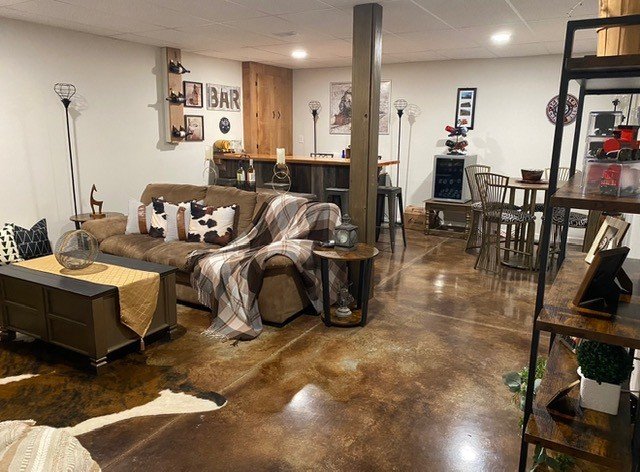
In the first installment of our Basement Rec Room Refresh, Part Une: The Plan, I shared our ideas for giving this finished—but never quite finished-feeling—space a moodier, more intentional direction.
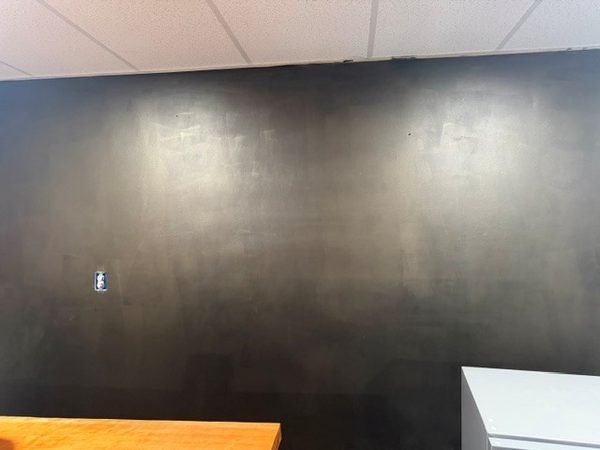
One of the biggest changes involved painting the large wall behind the bar. We planned to use Sherwin-Williams Tricorn Black, but not having quite enough paint on hand led us in a slightly different direction.
When You Don’t Have Enough Paint
We had just under one quart of Tricorn Black left from another project. It was enough to begin painting the wall, but probably not enough to finish it.
Rather than make an evening trip to Lowe’s for another gallon, Jeff suggested combining it with paint we already had.
Stored downstairs was roughly one-quarter of a gallon of metallic Blackened Bronze paint. I had originally purchased it for our basic drop-ceiling tiles, but that project began to feel overwhelming, and I was never completely convinced that a metallic finish would look right overhead.
Fortunately, the paint had already found its way into several other projects. We used it on the fireplace, the support pole, the curio cabinet, and the base of our over sized coffee table, so the color was already repeated throughout the room.
The question was: would this work on an entire wall?
Mixing Our Own Blackened Bronze Paint Color
This was not a carefully calculated designer paint formula. There were no test batches or exact measurements.
Jeff combined the remaining Tricorn Black together with the remaining Blackened Bronze metallic paint and hoped for the best. Our reasoning was simple: If we disliked the result, we could always paint over it.
As the first coat went onto the wall, the color appeared extremely dark—almost black in some areas and deep brown in others. The wet paint also looked uneven, which made me question whether our experiment was going to work.
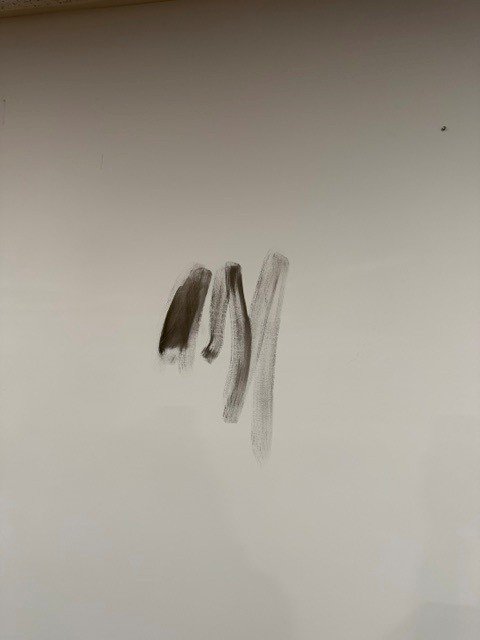
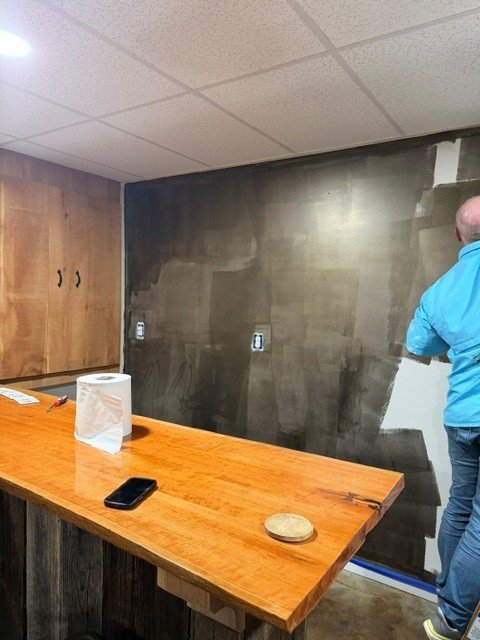
Once it dried, however, the color became richer and more dimensional. The Tricorn Black provided depth, while the metallic bronze added warmth and subtle movement. The finish reminds me of beautifully aged leather.
Because this was an improvised mixture, the color cannot be duplicated precisely. Anyone attempting something similar should combine a small test batch first and allow it to dry completely before committing to an entire wall.
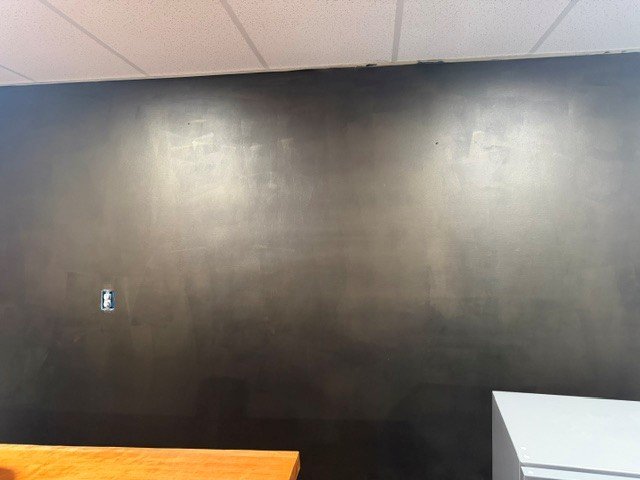
How the Blackened Bronze Paint Color Changed the Room
The new wall color gave the bar a stronger backdrop and helped define it as a separate area within the large, open space.
Its warmth complements the natural live-edge cherry bar top, aged walnut barn-wood base and acid-stained concrete floors. It also connects with the Blackened Bronze finishes already repeated throughout the room.
At this stage, leaving the surrounding walls lighter prevented the room from becoming uniformly dark. Instead, the blackened-bronze wall became a focal point while allowing the wood tones and collected railroad pieces to stand out.
Using Leftover Paint Kept the Cost Down
The metallic Blackened Bronze paint cost approximately $100 per gallon when I bought it in 2021. The same paint is now listed on Amazon for approximately $134 per gallon, so it certainly isn’t an inexpensive product.
For this project, however, we didn’t purchase any new pain. The wall was completed with two partially used cans we already owned.
It was a good reminder that leftover paint can be used for more than touch-ups. Compatible paints can sometimes create an entirely new finish, although I strongly recommend testing a small amount first if you aren’t prepared to repaint.
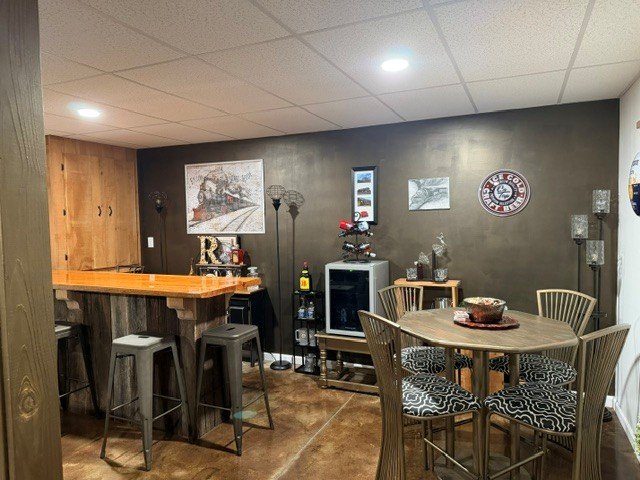
Our mixture wasn’t the color we originally planned, but it gave the bar wall warmth, depth and aged character it had been missing.
Next, in Part Trois, I’ll turn to the styling—editing what was already in the room, rearranging several pieces and adding a few carefully chosen accessories.
The Metallic Blackened Bronze Paint We Used

Leave a Reply